Order of the Sinking Star lets you recover from puzzle deadlocks by rewinding individual moves or returning to the beginning of a level or checkpoint. Use the reset action shown in your current controls, then inspect the restored board before replaying. A reset can remove a long stretch of useful setup, so a smaller rollback is often preferable when you know which move went wrong.
Do not assume every large puzzle has a checkpoint close to the place where you are stuck. The opening Vault of the Beamcasters can involve substantial preparation without a nearby checkpoint. This guide explains how to choose and evaluate a reset; it does not claim exact checkpoint locations or a universal reset destination for every room.
Decide what state you need to recover
Before resetting, identify the condition that has become unavailable. It might be a necessary stone, a character's access to an object, or a route through a sequence of devices. The reset is useful only if its returned state gives you another opportunity to create that condition.
If the failure followed one clear movement, use undo first. Inspect whether the needed access returns. If it does, revise that action without discarding the rest of the setup. If the relevant object was moved much earlier, follow the history back to the point where it was still usable.
Choose a reset when the current attempt is difficult to understand or a clean starting arrangement is the most useful basis for a new plan. Resetting should change how you approach the room, not merely make the same sequence easier to repeat.
Keep the distinction concrete. Rewinding to a useful decision point preserves valid preparation. Restarting from the level or checkpoint trades that preparation for a clearer board. Neither operation automatically supplies the insight needed to avoid the deadlock again.
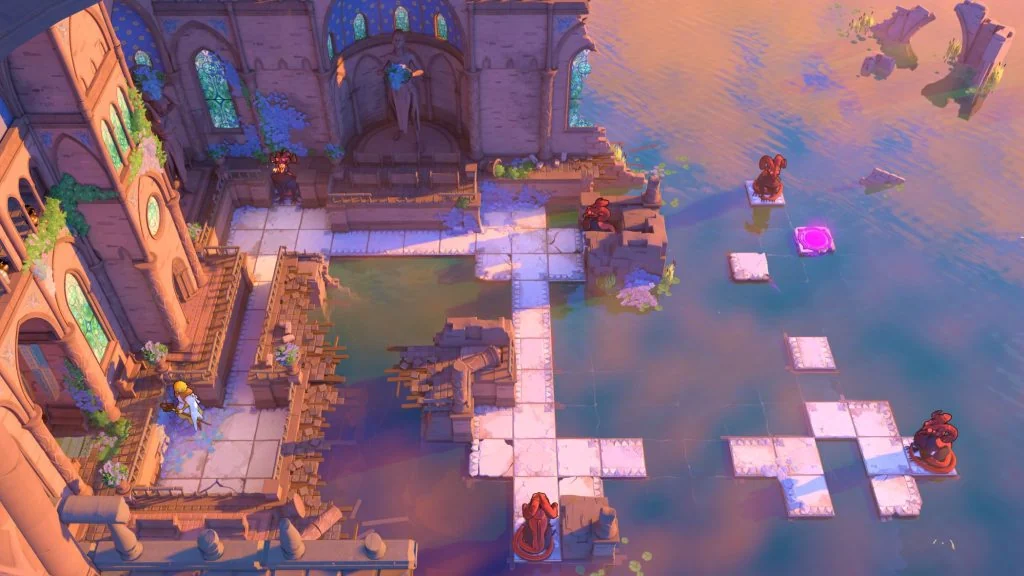
Inspect the current character position and available floor before choosing a rollback.
Distinguish a checkpoint from a promising arrangement
A board can feel like a natural stopping point without being an actual checkpoint. You may have finished a difficult object setup, reached another island, or opened a passage. Those events are useful milestones in your reasoning, but they do not establish a new reset destination by themselves.
Use the checkpoint or restart information the game actually presents. Do not infer that every crossing or major interaction is stored as a checkpoint. If the next part fails, that assumption can turn what seemed like a short reset into a much longer return through the room.
This matters in large connected puzzles. A later scene can depend on objects arranged far earlier. The apparent boundary between two sections is not proof that their states are independent. Inspect which earlier objects still contribute to the later route before treating the next scene as a fresh board.
For a difficult section, keep the necessary preparation clear enough to reconstruct. Identify the object roles and access points instead of relying only on the sense that the last few minutes went well. That way, if a reset returns farther than you expected, you know which conditions must be built again.
Inspect the board immediately after resetting
Once the reset has occurred, stop before making a movement. Identify where the character is, which important objects are present, and which passages or devices have returned to their starting arrangement. Compare that state with the checkpoint or level beginning you intended to revisit.
If the restored arrangement looks farther back than expected, do not treat the difference as proof that the save is damaged. A reset is a puzzle-state operation, and the destination may precede the section you were considering a milestone. Verify the actual returned board.
If the arrangement still contains the blockage, check whether you left the puzzle and returned rather than using a reset. Returning through the overworld can preserve an unfinished board and its history. The game can therefore show the same failed arrangement after a change of region.
Only continue when you can describe the starting state for the next attempt. That prevents you from following a remembered sequence from the wrong point and mistaking the resulting mismatch for another problem with the room.
Use the smaller recovery when the mistake is known
Resetting is available for substantial failures, but it does not have to be your first response to every error. A single movement that blocks a necessary route often has a clearer local recovery.
- Identify the lost access or displaced object.
- Undo the most recent action and inspect the relevant positions.
- Continue backward only while the necessary condition remains unavailable.
- Stop when you reach a board that supports the next required action.
- Change the preparation or order that caused the failure.
- Verify the revised arrangement before continuing.
The visible failure can occur after the underlying mistake. For instance, you may discover that a character cannot reach an object only when it is their turn to act. The earlier movement that closed the route is the useful recovery target, rather than the final unsuccessful input.
If you cannot locate that point, a reset can make the sequence easier to reason about. Before restarting, identify at least one condition the new attempt must preserve. Otherwise the fresh board may lead back to the same obstruction.
Recover an early Skipping Stones deadlock
The first Skipping Stones area provides a release-era example of why returning to the overworld and resetting are different. A player moved stones while pursuing a side route and then lacked the accessible arrangement needed to continue. They initially assumed leaving for the overworld had cleared the undo history.
The available recovery was to return and rewind the earlier movements. That made it possible to reach the level's beginning again. The important lesson is that a departure through the overworld did not itself remove the history of that unfinished attempt.
Use that lesson for diagnosis, not as a claim that your exact stone layout has the same solution. Inspect which stones your current route still makes available. If an earlier diversion consumed the arrangement needed for the main path, return to the decision before that diversion rather than trying to repair every later consequence.
The example does not establish a universal rule for completing, exiting, and replaying all levels. Finishing a level is a different event from leaving an unfinished attempt for the overworld. Do not assume the history of a completed replay will behave exactly like the history of the board you temporarily left.
Plan a side route before committing shared objects
In a large puzzle, an optional-looking route can use objects that also support later progress. Before committing a stone or crystal, inspect where else it might be needed and whether you can return it to a useful position.
This does not mean every secret must wait until the main route is finished. It means the object arrangement is shared. A tempting crossing can be possible while leaving the remaining level difficult or impossible to continue from that state. If the route consumes access you still need, undo or reset becomes part of the recovery.
For your next attempt, separate exploration from commitment. Use the wider view to inspect available land, devices, and stones. Decide which object supplies which required connection. Then pursue the side route only when you understand what remains available afterward.
If the board is already deadlocked, do not infer a hidden requirement simply because the object count now looks insufficient. Inspect the earlier decisions first. An object might be inaccessible because of your current arrangement rather than absent from the level. Returning to an earlier state is a way to test that distinction.
Allow for long sections without a nearby checkpoint
The western Vault of the Beamcasters can make resetting especially costly because its opening involves an elaborate setup and no nearby checkpoint. A large visible board does not guarantee that the restart point sits just before the current obstacle.
Before resetting there, inspect whether the failure can be corrected locally. Identify the beam-related route or object arrangement that stopped working. If undo can restore the necessary condition, use that smaller recovery and preserve the preparation that still works.
Use a wider view to take stock of the board. A local movement can depend on a device or passage elsewhere, so inspect the broader connection before concluding that the entire attempt must be restarted. The reset may still be the right choice, but it should follow from the current arrangement rather than from an assumed checkpoint that has not been confirmed.
If you restart, rebuild the useful sequence in stages. Verify each required condition before proceeding to the next section. This does not create new checkpoints; it gives you understandable decision points within the attempt so a later error is easier to locate.
Keep puzzle recovery separate from campaign progress
A checkpoint or level reset concerns the active puzzle arrangement. It should not be treated as a reason to start a new game, remove save files, or rebuild the whole campaign. Use the in-game recovery action for an in-room deadlock.
At the same time, do not assume a reset preserves every presentation detail or discovery state exactly as you expect. The available information does not establish a complete map-discovery or replay-persistence rule for every area. Inspect what the game actually restored in the current puzzle.
For progress outside the room, keep your observations separate. A changed object arrangement after reset does not by itself tell you whether a completed puzzle is still recorded elsewhere. Likewise, returning to the same unfinished arrangement after visiting another region does not mean the game failed to save; that arrangement may be the state it retained.
This distinction keeps recovery proportionate to the problem. If the next movement is unavailable because an object is trapped, use undo or the room reset. Do not escalate a local geometry problem into an unverified diagnosis of save corruption.
Start the next attempt with one changed decision
After reaching the level or checkpoint start, identify the decision that will differ from the previous attempt. Keep an essential pushing side available, avoid committing a needed stone to a side route, or position the next character before closing a corridor.
Test that change at the point where the old sequence lost access. If it succeeds, continue and inspect the next dependency. If it fails, use the available history to return to the same clear decision point. A reset is most productive when it supports a revised plan you can evaluate.
When no new idea is available, leaving for another region can be more useful than repeating the same restart. Return later with a specific condition to investigate. The recovery tools let you revisit the board; deciding which condition must survive is what turns that return into progress.