In Order of the Sinking Star, Mirror Isles clones arise from the reflection mechanic. Treat a reflection as a possible new position, then inspect how many actual characters occupy the board after the action. Creating another copy and moving an existing copy are different operations. Do not assume that every room containing two Traders controls them simultaneously.
A June demo puzzle starts with two copies that can be selected separately. The demo's duplication puzzles also use multiple reflections and merging to change the number of copies. Those detailed examples are useful for recognizing the mechanic, but their room layouts and completion requirements should not be assumed to match every release puzzle. This guide explains how to read the resulting positions; it does not provide an unverified movement sequence for a particular clone room.
Distinguish the character from its reflected destination
A mirror image and a character standing on the board are not the same state. The reflected destination tells you where a mirror operation can place a character. Once the operation occurs, inspect the physical character positions again before issuing a movement input.
That distinction is particularly useful when the board appears to contain several versions of the Trader. Some positions may be reflections rather than independently occupied tiles. Trying to count everything that looks like a character can make it seem as though a copy disappeared unexpectedly when only the reflected arrangement changed.
Before each mirror action, identify the current character tile, the mirror involved, and the destination associated with that mirror. After the action, count the occupied character tiles separately from the previewed reflections. This gives you a clear before-and-after comparison instead of relying on an impression of how crowded the screen looks.
Use a wider view if the reflected destination lies on another island. A copy outside the immediate camera area can still matter to your plan. The purpose of the wider inspection is to follow the complete arrangement, not to infer that a distant image must be a controllable clone.
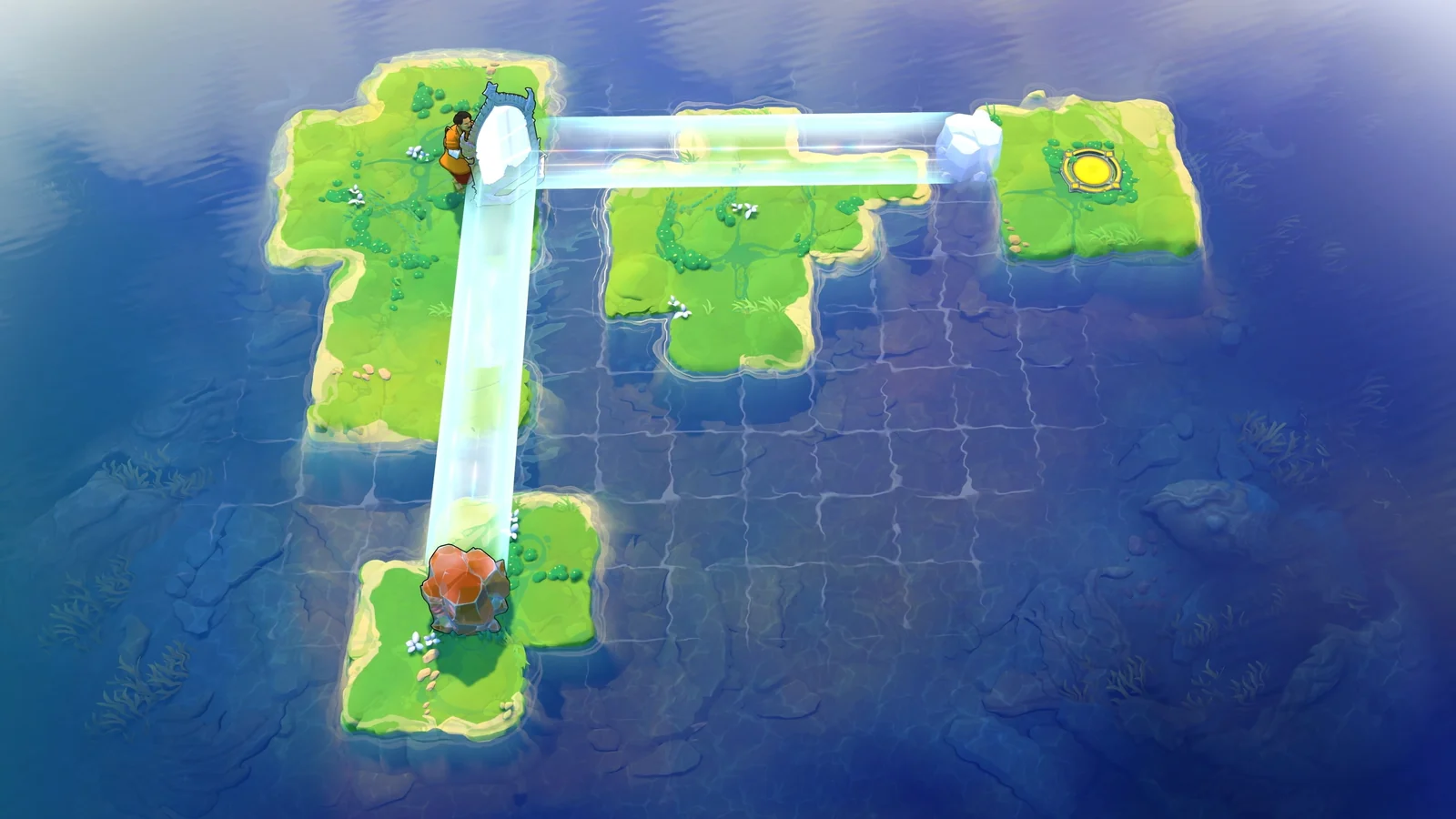
Follow the character’s occupied tile separately from the mirror’s projected route.
Read the demo's duplication and merging rule
In the June demo's duplication explanation, a character reflected through one mirror moves to its corresponding reflected position. When two mirrors produce two reflections at once, the operation can create two copies from one starting character. The important condition is the available reflections, rather than simply the number of mirrors visible anywhere in the room.
The reverse relationship can merge identical copies. If two identical characters would arrive at the same location during reflection, they become one. A character and a rock are different objects; bringing them to one position is not the same merging operation.
This gives you two things to inspect before acting: how many destinations the current mirrors provide, and whether destinations for existing copies coincide. A change in clone count is therefore a spatial result of the arrangement. It does not need to mean that the input failed or that the game randomly removed a character.
Apply this explanation only to a board that presents the matching behavior. If your release room behaves differently or contains another mechanic, judge the visible result rather than forcing a demo example onto it. Clone count, movement behavior, and success conditions must all be read from the particular puzzle.
Determine whether your room permits separate selection
The demo's pale orange star puzzle is an example of a board with two Traders already present and the ability to switch between them. That matters because a clone puzzle can ask you to manipulate the spacing between two independently positioned characters. A guide that assumes all copies always move together would miss the central task of that room.
Before planning a long route, try a small, reversible observation. Select a different character if the room provides that action. Make one movement and inspect which physical character changed tiles. Undo if the test disturbed your setup. This establishes what you are controlling before you commit to a larger arrangement.
Do not interpret a mirror operation as ordinary character selection. Reflection changes positions and can change the number of characters. Switching selects an existing character for subsequent actions. Confusing the two can leave you looking for a second copy after you have actually merged it, or expecting a reflection to remain fixed while you change the selected character.
For a room that moves several copies together, inspect the movement result for every copy. For a room that selects them separately, inspect the inactive copy's position before moving the active one. Either way, the board contains more state than the position of the character currently drawing your attention.
Plan spacing rather than only the next island
Clone puzzles can use the distance between characters as part of the solution. In the demo's pale orange star example, increasing the horizontal separation between two Traders is an essential idea. The room uses a right-angled mirror to convert space in one direction into space in the other.
For that type of puzzle, reaching another island is only an intermediate goal. Check whether the resulting arrangement increases, decreases, or preserves the separation you need. A successful crossing can still leave both copies too close together for the next reflection.
Count tiles from each character to the relevant mirror rather than estimating distances from perspective. Inspect both the starting position and the reflected destination. If a mirror changes a horizontal relationship into a vertical one, compare those distances on the grid. The next adjustment should address the relationship that failed, not just move the mirror farther toward the edge.
This is a way to analyze the geometry, not a claim that every mirror uses an identical orientation. Look at the actual mirror and its visible destinations. A spacing technique that works in the demo's right-angled example may need a different arrangement in another room.
Track the objects that make clone positions usable
A desired clone position can lie beyond the floor that is currently reachable. The Mirror Isles use both mirrors and movable objects, so a character's final position may depend on first preparing a stone or crystal arrangement.
Keep the tasks separate. First determine the position required for the character or copy. Then inspect what must be present there for the position to serve the next action. If a stone creates a standing place or a connection, plan the stone's movement before placing the character. If the mirror must move again afterward, preserve the access needed to push it.
The demo's pale orange star hints connect the spacing problem with a crystal block and water. The useful lesson is that the available object is part of the geometry. It does not establish a universal instruction to push every crystal into water. Identify the role the object serves on the board you are solving.
When a character can reach the desired place but cannot continue, inspect the preparation rather than repeatedly reflecting the same character. You may have achieved the correct position too early, before the necessary route or object arrangement exists. Undo to the point where that preparation can still be performed.
Count physical characters before attempting the finish
In the demo's duplication discussion, the described yellow-exit puzzles require the character count to match the exit count. The example has three exit positions and requires three characters on them together, without an additional copy elsewhere. Keep that condition tied to those demo puzzles rather than treating it as the completion rule for every room in the release.
If you are playing a matching room, count all the physical copies before arranging them on the exits. If there are too many, inspect whether a merge can reduce the count. If there are too few, inspect whether a duplication arrangement can supply the missing copy. Adjusting the count after placing several characters on exits may disrupt the positions you already prepared.
A clone that can occupy a pressure plate is still part of the board. Check the effect of moving it before using it to create or merge another copy. The position may be supporting a route that your selected character needs. Similarly, hazards can affect clones, so an apparent loss of a character must be inspected as an event rather than assumed to be a successful merge.
Count and position are related, but they are separate checks. The right number of characters can still occupy the wrong destinations. The right destinations for some characters can still leave an unwanted copy elsewhere.
Diagnose an unexpected change with a short test
When you lose track of the copies, return to a state you can describe clearly:
- Count the current physical characters and note their tiles.
- Identify the mirror or mirrors relevant to the next action.
- Inspect the reflected destinations for the current arrangement.
- Perform only that action.
- Compare the new physical character count and positions.
- Undo before testing a different arrangement if the result disrupted your route.
If the count rises, inspect which distinct destinations created the extra copies. If it falls, inspect whether identical copies converged, or whether a hazard removed a character. If the count stays the same but the position is wrong, the issue is the projection geometry rather than duplication.
Do not combine several unexplained movements into the same test. A mirror movement, a character switch, and a reflection can each change what you see. Testing them together makes it harder to tell which operation caused the unexpected result. Once the immediate rule is clear, use it within the full puzzle sequence.
Keep the plan valid for every remaining copy
Before continuing from a promising arrangement, inspect the route for each character still needed. Can that copy reach its next action? Does moving the selected character obstruct it? Does the next reflection merge something you still need, or produce a copy in a position you cannot use?
This is also the point to decide whether you should keep the current state. Undo a local mistake when you understand which reflection produced it. Restart when many tests have made the board difficult to follow. If the geometry is understood but no useful arrangement is apparent, return later with one concrete condition to investigate, such as preserving access to a mirror while increasing the distance between the Traders.
The goal is a board in which every required copy has a purpose and a usable next action. Reaching one attractive destination is not sufficient if the operation leaves another necessary character stranded or changes the clone count in a way the room cannot use.